Academic Work
Below are samples of academic works I am most proud of, ranging from Marketing Communications campaigns & presentations to work that supplemented my double minor in Psychology and Health & Society.
Marketing Communications Work
Course: Fundraising for the Non-Profit
Course: MK-332-01 Qualitative & Quantitative Research Methods
-
As a partnership, we analyzed the research article "Five Seconds to the Ad…" to extract key insights on how viewers engage with skippable ads. We then applied those findings to real-world examples — specifically YouTube and Amazon Prime countdown ads — to demonstrate how the first few seconds of an ad determine whether audiences stay or skip.
-
Successfully present article findings & marketing implications to our peers
-
Tasked with studying a subculture outside our own, our team chose sorority culture. Through primary and secondary research, we explored how sorority women form identity, community, and buying habits — then pitched a Lululemon partnership as a natural fit for their lifestyle and values.
-
Research and analyze the buying habits of sorority culture, then pitch a brand partnership that authentically aligned with their lifestyle and values.
-
Our team selected Gymshark as the brand to pitch a new market entry into Boston. Through primary and secondary research, we analyzed the local fitness landscape, consumer demographics, and competitive environment — then synthesized our findings using IBM SPSS to statistically validate our recommendation. We ultimately made the case for Gymshark's entry into the Boston market.
-
Justify conclusion if Gymshark should or should not enter the Boston market
-
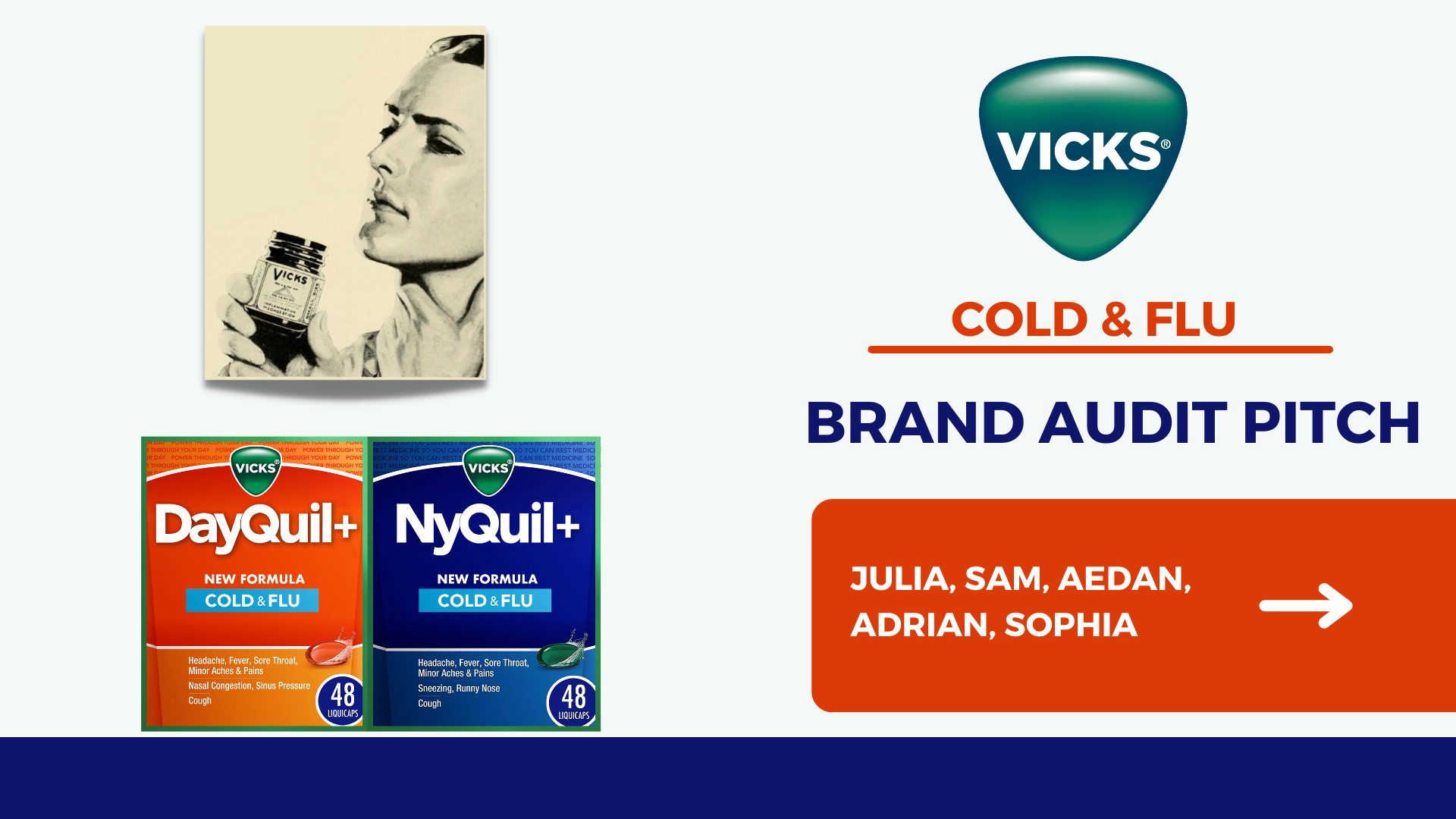
As a team of four, we tracked Vicks as our brand-in-the-news throughout the semester, analyzing the brand management crisis triggered by the FDA's ruling that phenylephrine — a key active ingredient in many Vicks products — was ineffective as an oral decongestant. Using core brand management frameworks, we audited Vicks' brand equity, critiqued how the brand handled the fallout, and developed strategic recommendations. Our proposed path forward centered on two priorities: reformulating affected products with a clinically supported alternative, and rebuilding consumer trust through transparent, proactive communication.
-
Successfully present a brand reconstruction
-
As partners, we analyzed research on brand schemas and ad congruency — exploring how the alignment (or misalignment) between an ad and a brand's established identity shapes audience attitude and purchase intention. We applied these concepts to real-world examples, including Mountain Dew's iconic "Puppy Monkey Baby" ad, to examine how unexpected or incongruent creative choices can both disrupt and reinforce brand perception.
-
Successfully present article findings & marketing implications to our peers
Psychology and Health & Society Work
Course: PS-201-01 Abnormal Psychology

Course: MK-220-02 Understanding Consumer Behavior
Course: MK-332-01 Qualitative & Quantitative Research Methods
Click to enlarge
Course: MK-222-01 Brands, Organizations, and Strategies
Course: MK-220-02 Understanding Consumer Behavior
-
Presentation detailing evidence of Art Therapy on patients with PTSD
-
Successfully research and present on research studies that used Art Therapy as a form of PTSD treatment and display key findings in a poster project

-
Fundraising for the Nonprofit partnered with a local Boston school to create a book drive campaign.
-
We were able to complete our goal of raising 100 books for the Ohrenberger School